
We Deserve Better Than Expensive Fakes
What I found when I finally looked closely at the spanish home brand everyone was following.

A note before we begin: I have chosen not to name the brand at the centre of this piece directly, because the goal here is not to target one operation. It is to describe an entire model.
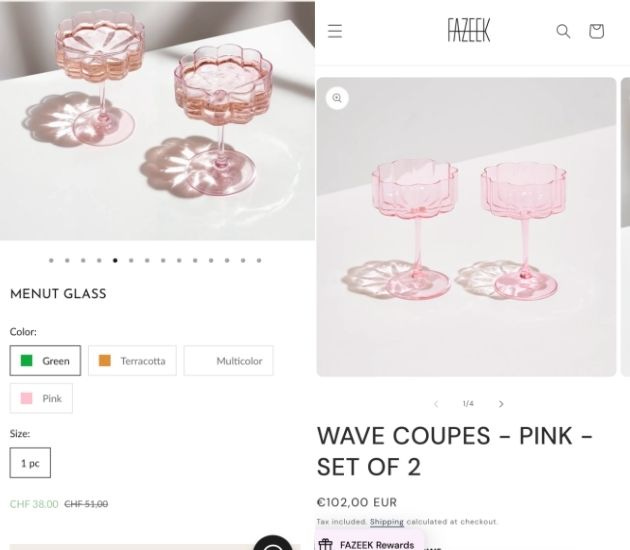
A few weeks ago I nearly bought glasses from an Instagram brand I had never heard of before. The aesthetic was right, the price felt considered, several people I know and trust in real life followed the account and so just like that I came very close to ordering.
I didn’t, and I’m glad. I have been buying things online from platforms I have never heard of before for years and been deceived very, very, rarely. I know how to read a product page, spot a suspicious website, and sense when something is off. And yet this one nearly got me. Not because the red flags weren’t there. Looking back, they were, AI-generated photography, a brand story that hits every expected box without a single verifiable detail behind it, product descriptions full of words like “craftmanship”and “noble materials” that never quite said who made what, or where, or how. But those signals were easy to dismiss when the people I trusted were already there, vouching for something they had probably never ordered from either. That borrowed credibility was enough to keep me browsing, and almost enough to make me buy.
What I found when I finally looked closely was not just one brand taking short cuts. It was a business model I had never encountered before.
The New Fake Is Not Cheap
There has always been a market for copies in home design. Knock-off Eames chairs, budget versions of iconic pendant lamps, replicas of a popular shelving system. A lot of people have bought something in this category, I believe I have, probably more than once. There is an entire market for this, it is legal in many cases depending on the age of the design and the jurisdiction, and when you buy from it you generally know what you are getting. The price tells you, The materials tell you, the brand or marketplace does not pretend to be something it is not (most of the time), and your expectations adjust accordingly.
What is different about the operations I want to talk about is the price point. Not low, not obviously suspicious, just high enough to feel like a “real” purchase and a meaningful one at the same time. A side table at €400, a floor lamp at €660, a sofa at over €4,000, these are not impulse prices. They are the prices of things you think about, research a little, and eventually decide are worth it. They are prices that lower your guard precisely because they seem to justify themselves. And not a single mention of the original designers behind the pieces they are reproducing.
This is the mechanism. The expensive fake does not look like a fake, it looks like a find.
What Happens When You Look Closer
When I finally researched this brand properly, the structure behind the aesthetic became visible quickly.
The legal entity behind the website was registered in New Mexico, one of the most permissive US states for LLC registration, with minimal public disclosure requirements and no named directors in filings. The customer service number had a Spanish prefix. The website described the brand as born in Spain. The founders, a spanish couple who left corporate jobs after years living between Europe, Morocco, and Kenya to build “a project that reflected their true essence: simplicity, beauty, purpose and freedom” had no verifiable trace anywhere outside the brand’s own pages.
The terms and conditions contained an unedited placeholder where an actual state name should have appeared. The legal documents had never been properly completed. The return policy, meanwhile, requires that any non-defective item be shipped back to a warehouse in China at the customer's expense. A Spanish brand, registered in New Mexico, returning goods to China.
None of this is visible when you are browsing the Instagram feed.
Stolen From People Who Actually Make Things
The catalog contained reproductions of several protected and well-documented designs. I recognised several pieces immediately. And yet I caught myself thinking: maybe they have licensing agreements, maybe I am wrong. The price felt too serious for a straight knockoff, and the people I trusted were already following them. Between the two, I talked myself out of what I actually knew.
They are prices that lower your guard precisely because they seem to justify themselves.
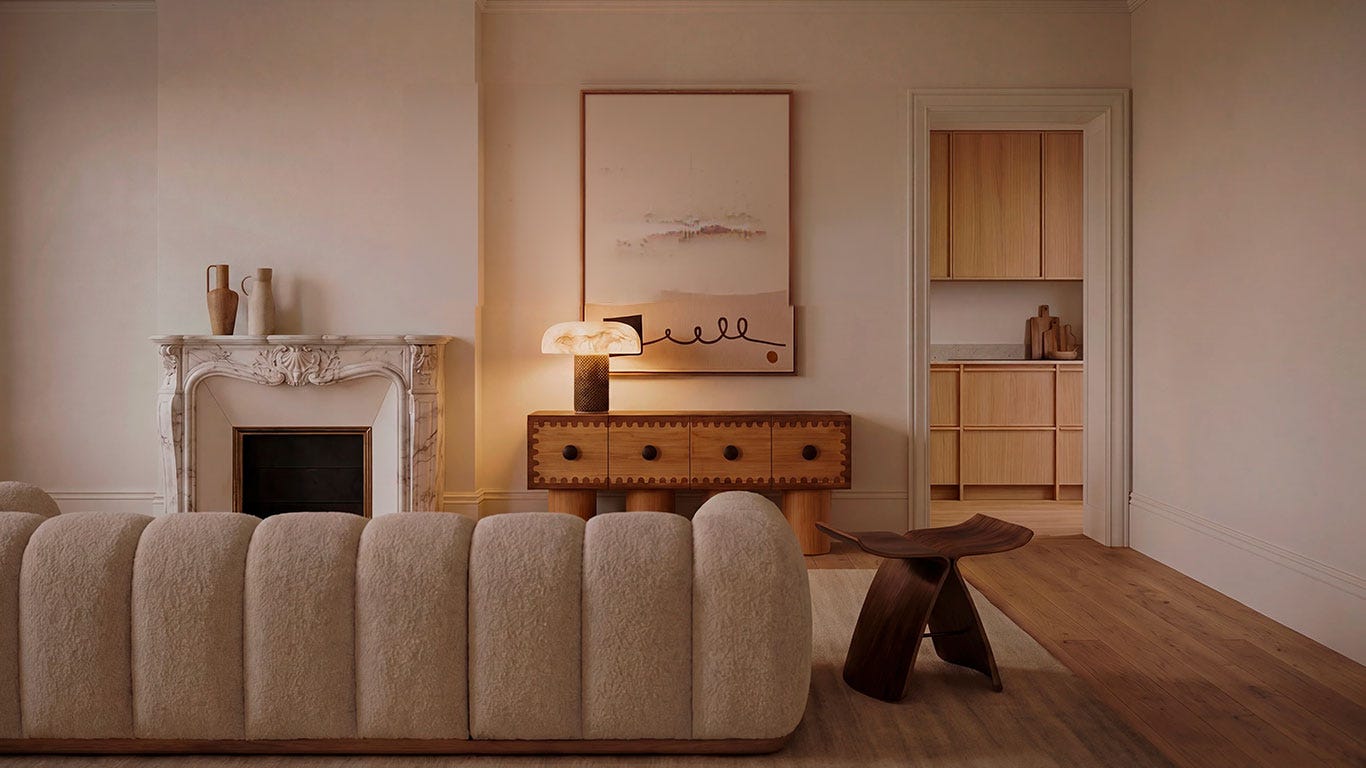
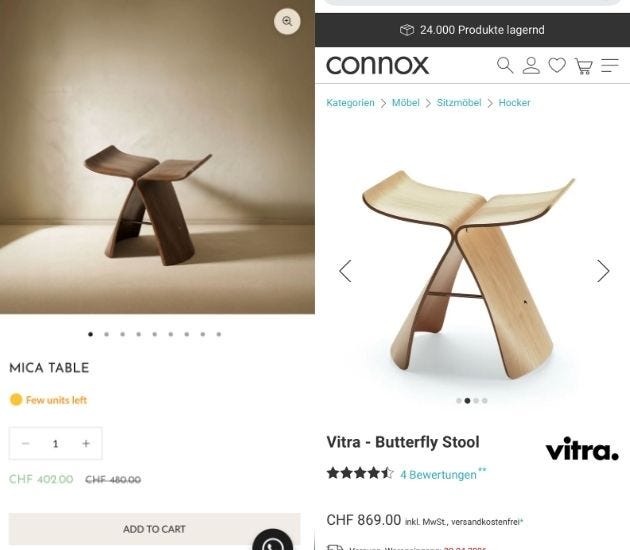
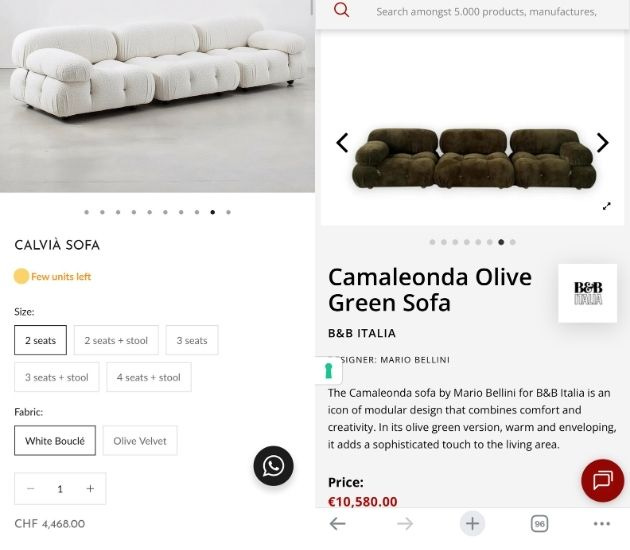
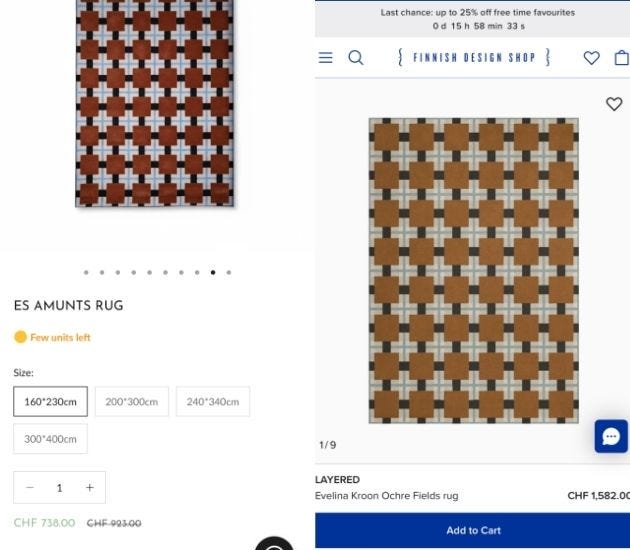
A side table reproducing the Butterfly Stool by Sori Yanagi, sold at €430 with no mention of Yanagi and no licence from Vitra, who holds distribution rights across Europe, Africa, and both Americas. A sofa reproducing the Camaleonda by Mario Bellini for B&B Italia, officially reissued in 2021. Glasses reproducing the signature Wave design by Australian brand Fazeek, hand-blown borosilicate originals replicated in standard pressed glass. A rug reproducing the Ochre Fields pattern by Swedish artist Evelina Kroon for LAYERED, a highly distinctive commissioned work that starts at €1,100, selling here for €600. I’m pretty sure this is only the tip of the iceberg. See for yourself :
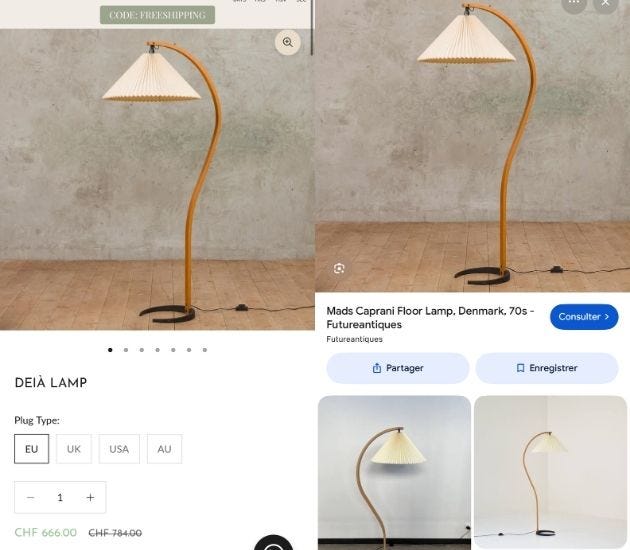
One case goes further than reproduction. Rather than generating an AI image, they lifted the actual photograph of a vintage Danish original by designer Mads Caprani directly from an antique dealer's listing. Identical wall, identical floor, identical cable position
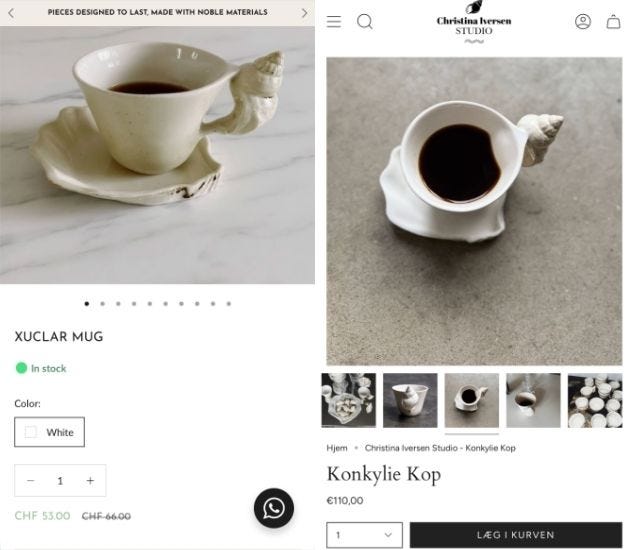
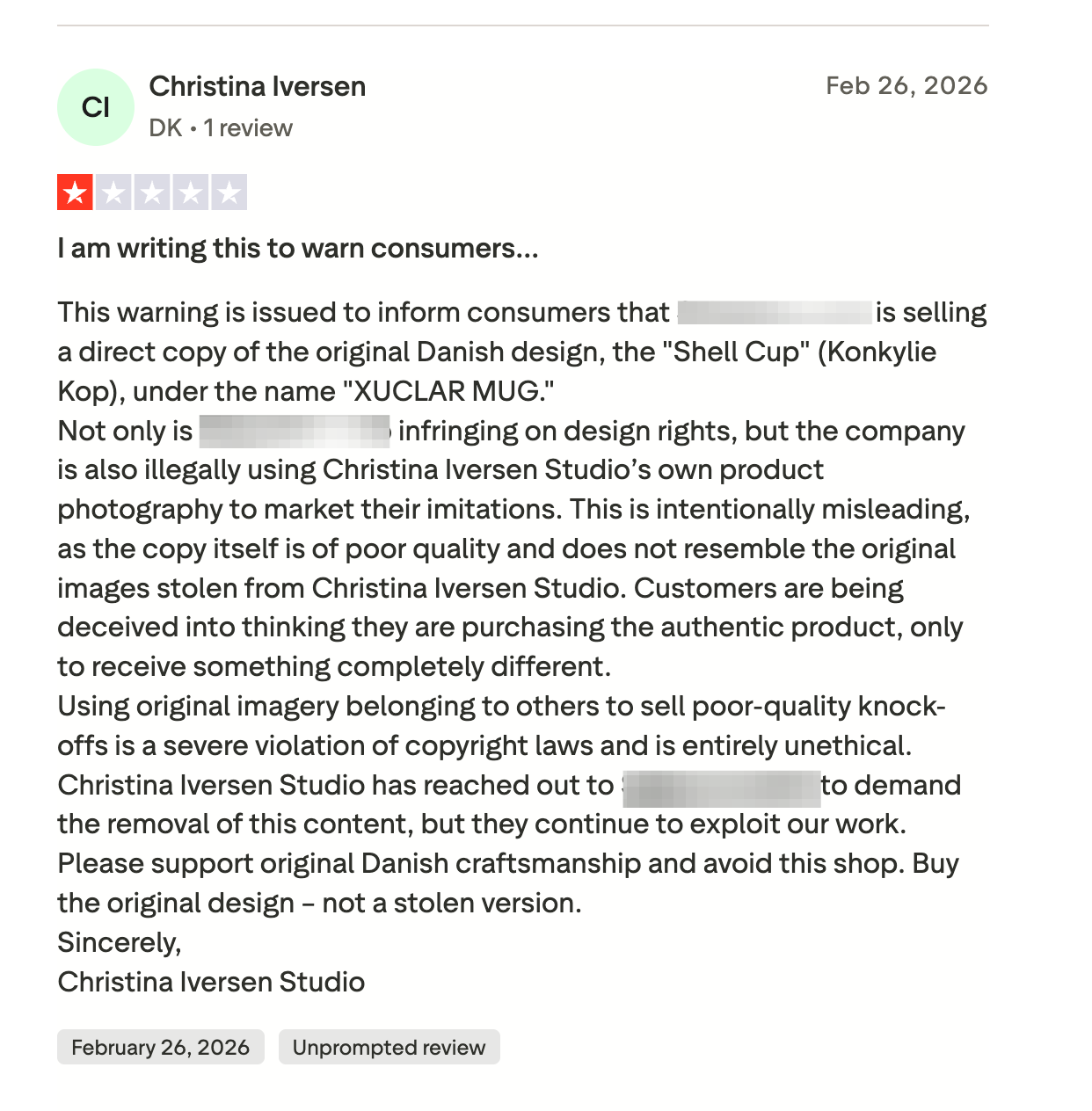
And then there is the case that was documented publicly by the designer herself. Christina Iversen Studio, a Danish ceramics brand, posted a warning on Trustpilot stating that the brand was selling a copy of their Shell Cup using Christina Iversen’s own product photography to market it. The studio contacted the brand and requested removal. The brand did not comply.
When a Swedish customer raised questions about design similarities in a December 2025 Trustpilot review, she found that her account and the accounts of the designers she followed had been blocked. No response to the question, just a block :
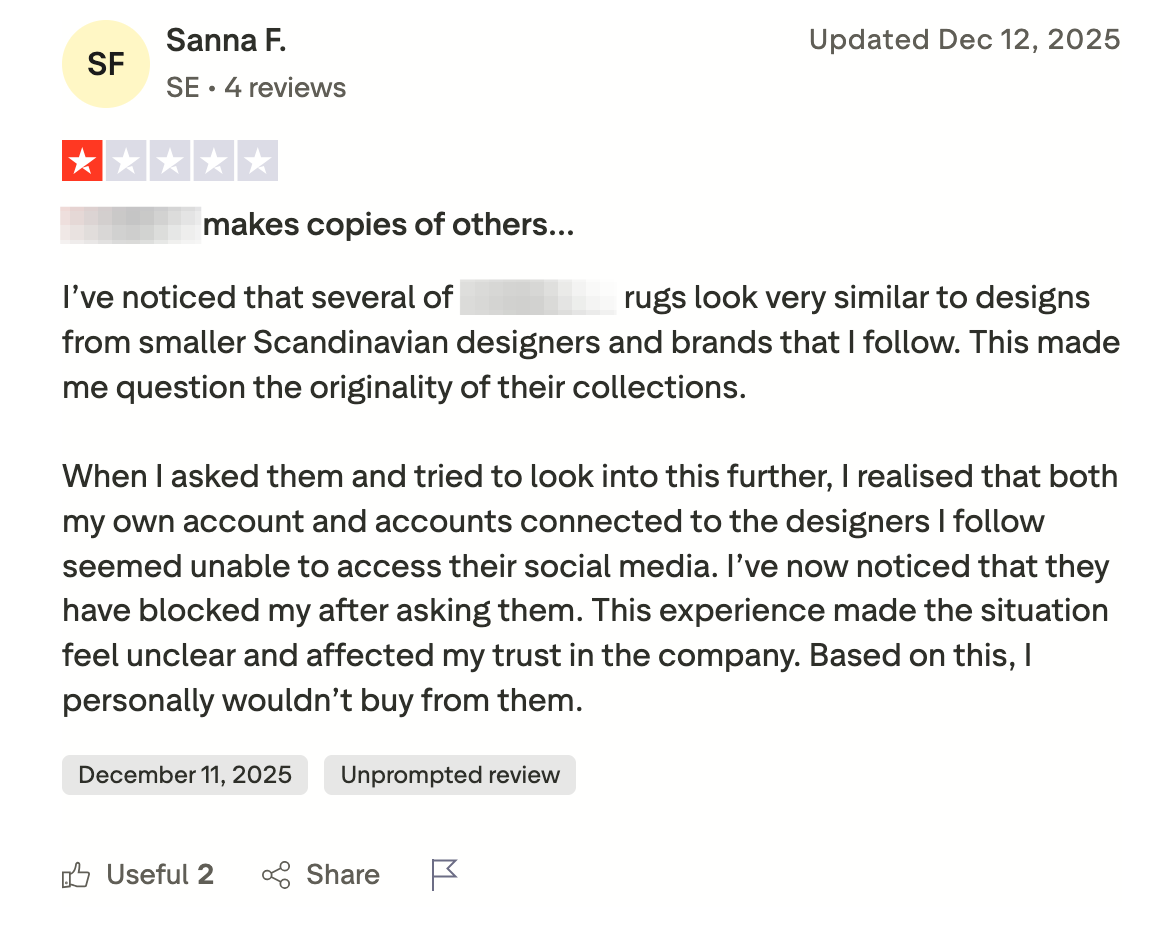
This is not a brand making honest mistakes. It is a brand that knows exactly what it is doing and has built systems to manage the consequences.
The Designers Have No Easy Path Either
It is worth pausing on what this looks like from the designer side.
Evelina Kroon is a Stockholm-based artist. Her rug collection with LAYERED is a commissioned named work with a documented creative history. Seeing it reproduced and sold, with a different inferior product shipped to customers, is not an abstract intellectual property issue. It is her work being used to deceive people, and her reputation indirectly implicated when those customers receive something that does not match what they ordered.
Christina Iversen Studio tried the most direct possible approach. They contacted the brand, identified the violation, and asked for it to be taken down. Nothing happened.
For small studios and independent designers, pursuing legal action across jurisdictions against a company structured for opacity, with an address in New Mexico and operations apparently running through Spain and China, requires resources that most independent creators do not have. The law exists in theory. In practice, for this category of operation, it is largely inaccessible.
The thing is that as a consumer, and as a designer, you have limited recourse. The system is not built to stop this efficiently. Which means the most practical thing is to spend two minutes before spending hundreds of euros, doing a few simple checks (see end of article for my checklist). Not because individual vigilance fixes a systemic problem, it doesn’t, but because the fewer people these operations can fool, the less viable they become.
What You Are Actually Buying
There is a question worth asking before spending €600 on a rug from a brand you found on Instagram: what are you actually purchasing?
The Trustpilot reviews for this brand tell a consistent story under the surface positivity. Products shipped from China. Delivery times stretching to weeks. Items arriving that do not match what was photographed. An “artisanal” disclaimer deployed whenever the product fails to match expectations. One customer paid €1,500 for a lamp advertised as European-made, received a defective product sourced from China, and when a replacement was sent, it arrived with a customs declaration valuing it at $50.
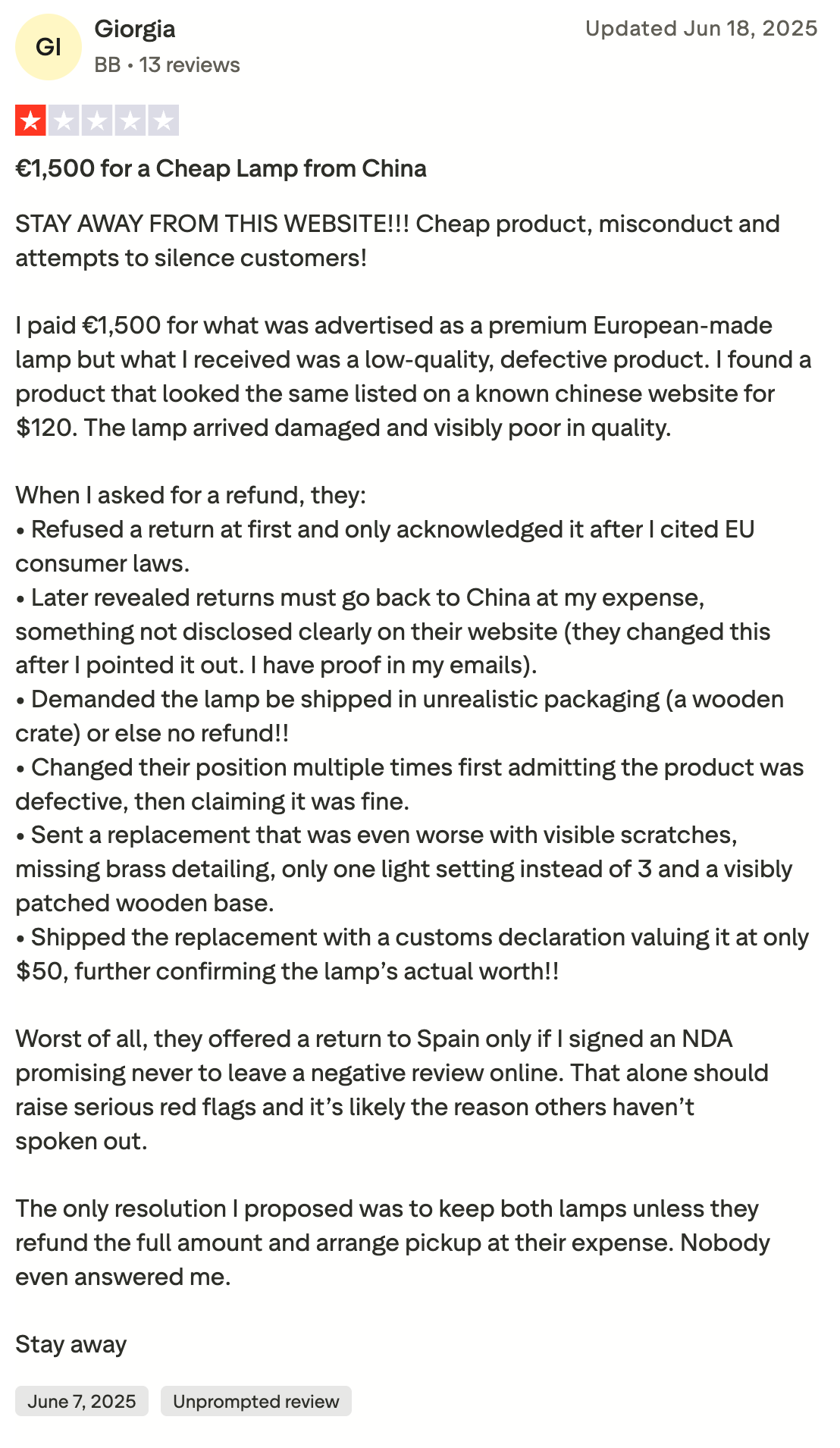
A business registered as an LLC in New Mexico with no named directors, sourcing from Chinese warehouses, with legal documents that were never properly completed, is not producing handcrafted Mediterranean pieces. Moreover, none of this catalog was photographed. What you are browsing is a collection of AI-generated rooms, stolen photographs, and borrowed designs, assembled to look like a brand. The story and the product are entirely disconnected. You are paying for the story.
And the story is funded partly by you even before you spend a single euro. Every follow on Instagram is a signal. When design-literate people we respect follow a brand, we grant it a credibility it has not necessarily earned. That follower count is not vanity. It is the engine of the whole operation.
You are not missing out by not following a brand you are not sure about. You are just not lending it something it hasn’t earned. And that, matters more than it seems.
What makes this particularly scary is how replicable it is. A Shopify store, an LLC registered for $50 in a state chosen for its opacity, a Chinese manufacturer willing to reproduce any silhouette you send them, an AI image generator, a coherent Instagram aesthetic are all it takes. The product never needs to exist until someone orders it. The brand never needs to be real. The only thing that needs to work is the story, and the story only needs to hold long enough for the payment to go through.
This is not an isolated case. It is a template. And nothing about that template is difficult to copy.
One Last thing
Before we wrap up, one small thing worth thinking about.
Following an account is rarely a neutral act. It is often a way of signalling belonging, of saying I know this, I found it first, I am the kind of person who follows this kind of brand. That is not a flaw. It is a profoundly human impulse, and these operations are built to exploit it.
It feels like a low-stakes gesture, but on Instagram, that gesture is visible to everyone who comes after us, and it carries weight we rarely think about. A follow is a small but real unit of social credibility. The next person who discovers a brand will notice who already follows it, and they will use that, consciously or not, to decide whether to trust what they are looking at.
You are not missing out by not following a brand you are not sure about. You are just not lending it something it hasn’t earned. And that, matters more than it seems.
We deserve better than expensive fakes. Obviously we do. But what we deserve above all is to be told the truth. Because what is being sold here is not a budget alternative with honest limitations. It is something far more insidious: the feeling that you are buying a well-made, thoughtfully sourced piece from people who genuinely care about design. That feeling is the product. And it is the only original thing in their catalog. Make no mistake: this is not a brand that cuts corners. It is a brand built on the premise that you won't look closely enough to notice.
And the first step to protecting yourself from it is simply knowing it exists.
Do this before you order from any brand or market place you find on Instagram or elsewhere
A first quick check takes less than five minutes:
Find the legal entity. Look for the Terms & Conditions or Legal Notice page. A lifestyle brand registered as an LLC in a US state known for minimal disclosure requirements, with a customer service number in a different country and no physical address, deserves a second look.
Check Trustpilot and read the negative reviews. Shipping origin, delivery times, product discrepancies, and how the brand responds to complaints tell you more than any five-star summary.
Read the return policy before you buy. If returning a non-defective item requires shipping it to a warehouse in China at your own expense, covering import duties on the return, that is the real policy, regardless of what the About page says.
If one of the above feels off, go further:
Reverse image search the product photos. Drag any hero image into Google Images. If it appears in another listing, a designer studio’s portfolio, or another brand’s page, you have your answer.
Search the founders independently. No press mentions, no LinkedIn, no presence anywhere outside their own About page is a might be a signal.
Look at the photography. AI-generated images are getting better, but they still tend to feel slightly off: lighting that doesn’t quite work, shadows in the wrong place, and an overall texture that looks too smooth, almost velvety. A catalog with no real interiors, no real people, and no real objects is worth questioning. Real brands photograph real things.
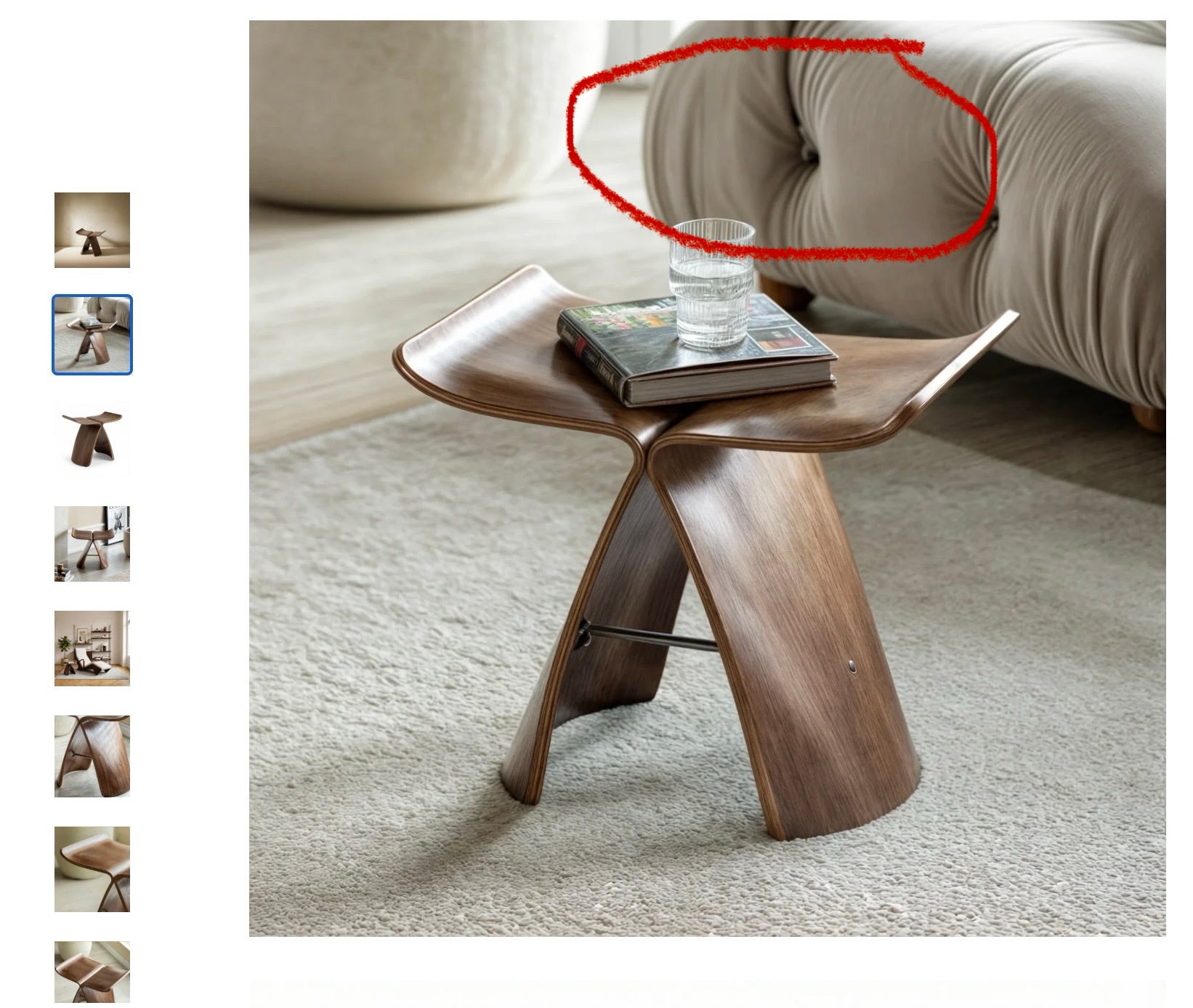
All screenshots referenced in this piece were captured in March/April 2026. Product pages, legal notices, and return policies cited were publicly accessible at time of publication.